Diamond guide
A clear guide to diamonds.
Diamonds are sold in a language nobody ever properly explained to most buyers. Shape, cut, the four Cs — it sounds like a glossary you only have to recite. Here you will find what any of it actually looks like on a finished jewel. No prices, no configurator.
Facts from GIA · Drawings by the Cylinder atelier
The first thing the jargon merges
Shape is not cut.
Shape is the outline of the stone viewed face-up. Cut is the arrangement of the facets — how those polished planes are laid out and angled. It sounds like a detail. It is not: the same outline can be faceted in several ways, and each one handles light differently. Which is why “I want an emerald” never means the outline alone.
Emerald and radiant share almost the same outline. Emerald is a step cut: parallel facets like steps that reveal the inside of the stone and give broad flashes. Radiant carries brilliant facets converging on the centre and sparkles. The difference is not the shape — it is the cut.
Shape — the outline, face-up
Cut — the facet arrangement
Emerald
Radiant
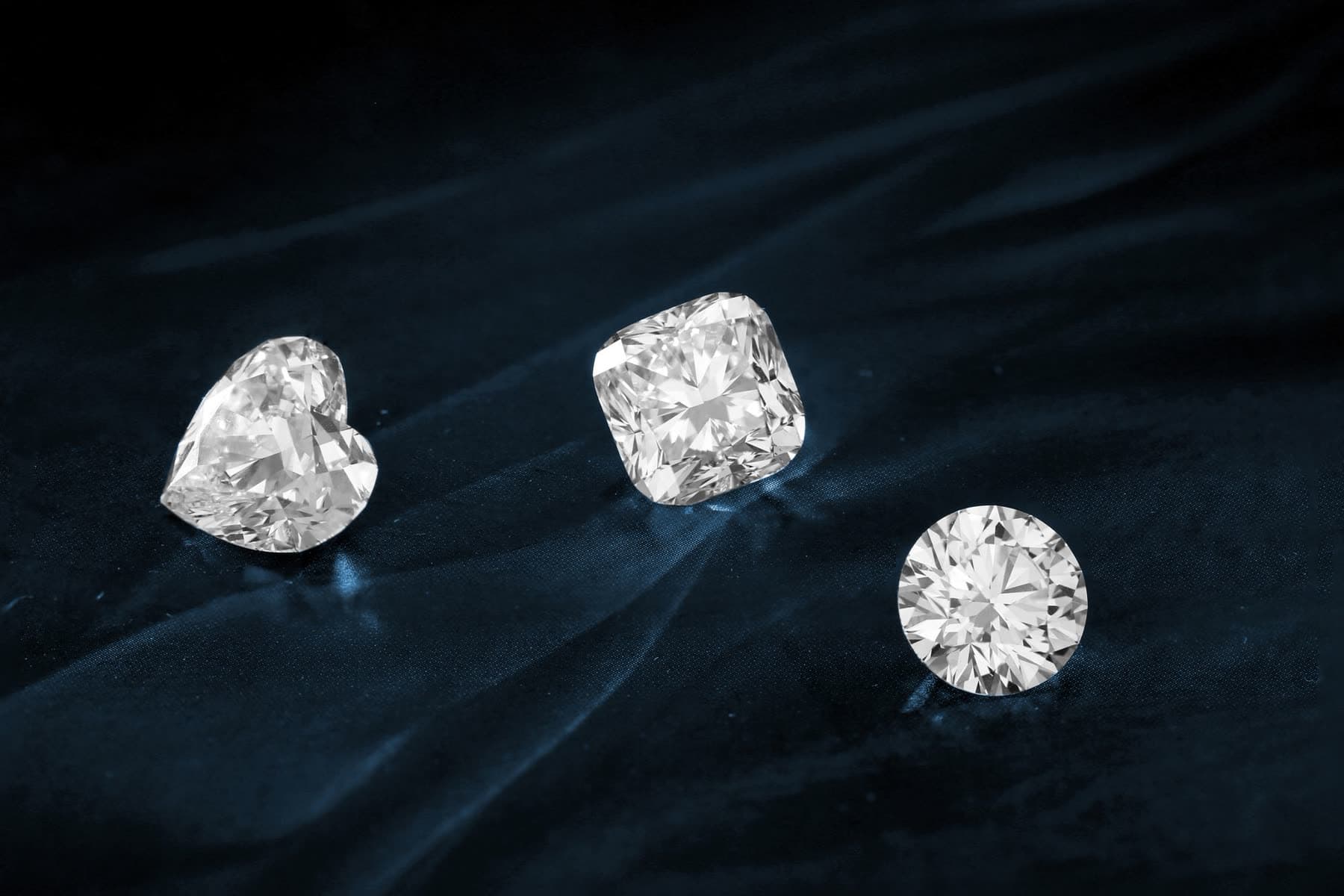
Atlas of shapes
The ten shapes you will meet most often.
The most common family is the brilliant cut — kite-shaped and triangular facets arranged to return light to the eye. The second is the step cut: parallel facets that create broad reflections rather than a busy sparkle. These are schematic face-up views; an individual stone may differ in the details.
Round brilliant
Brilliant cut
The best-known shape and the only one GIA assigns a cut grade to. Its facets run the full circumference, so the stone works with light from every direction.
Oval
Brilliant cut
An elongated outline with brilliant facets. It reads long on the hand, and the setting has no points to protect — there are none.
Pear
Brilliant cut
One point and a rounded base, so a single axis of symmetry. The point is the most vulnerable part of the stone, which is why the setting has to cover it.
Marquise
Brilliant cut
Two points and a narrow, elongated outline. It demands exact symmetry — on this shape any asymmetry shows immediately.
Princess
Brilliant cut
A square outline with brilliant facets. The sharp corners carry a risk of chipping, so they belong under the protection of the setting.
Emerald
Step cut
A rectangle with cut corners and a step cut. Its parallel facets open the inside of the stone, so clarity is more visible here than on brilliant cuts.
Radiant
Brilliant cut
Close to the emerald in outline but with brilliant facets. Exactly the case where the same shape and a different cut produce a completely different stone.
Asscher
Step cut
The square version of the step cut, with cut corners. The inside of the stone reads as a hall of mirrors receding into depth.
Cushion
Brilliant cut
A rounded square or rectangle with brilliant facets. The soft outline and wider facets give calmer, larger flashes.
Heart
Brilliant cut
A brilliant cut on the most demanding outline. It lives or dies on the symmetry of the two lobes and a clean cleft between them.
The four Cs
What is actually being graded.
GIA created the four Cs as a common language. Most people read them as four equally important pillars of quality — and that is the one misleading thing about them. Each speaks about something different, and each reaches the finished look to a different degree.
Cut
It decides what you will see.
Cut decides whether light returns upward to the eye or escapes through the pavilion. Two stones with identical proportions on paper can look nothing alike — what decides is the angle and the precision of the work, not depth on its own. Under a mediocre cut, the other three Cs lose much of their meaning.
GIA assigns a cut grade to the standard round brilliant and assesses seven components: brightness, fire, scintillation, weight ratio, girdle thickness, symmetry and polish.
Colour
A D-to-Z scale, 23 grades.
What is graded is how close the stone comes to being entirely colourless. D is colourless; Z carries a light yellow, brown or grey tint. A one-grade difference is so slight that even a goldsmith would rather take the stone out of its setting and compare it against a white background. With the naked eye you will reliably see it only two or three grades apart.
D — Z (the normal colour range)
Clarity
Eleven grades, from FL to I3.
It describes internal inclusions and surface characteristics. Most natural diamonds fall into the VS or SI categories — and those small inclusions are precisely what makes a natural stone singular. On step cuts such as emerald or Asscher, the inside of the stone is more visible than on brilliant cuts.

FL

VS1

SI1

I1
Carat weight
Weight, not size.
One metric carat is 0.2 grams — 200 milligrams — and divides into 100 points. But carat tells you what the stone weighs, not how large it will look. A stone cut deeper can carry more weight and still show a smaller visible diameter. A big number sells more easily than good proportion.
1 ct = 0.2 g = 200 mg = 100 points
0.005 ct
1 mm
0.015 ct
1.5 mm
0.025 ct
1.8 mm
0.05 ct
2.3 mm
0.10 ct
2.95 mm
0.15 ct
3.4 mm
0.20 ct
3.8 mm
0.25 ct
4 mm
0.50 ct
5.2 mm
0.75 ct
5.9 mm
1.00 ct
6.5 mm
1.50 ct
7.4 mm
2.00 ct
8.2 mm
The master's view
Which C decides what you will see every day?
All four Cs have their place. The difference is only that they do not shape the final look to the same degree — and once the sales noise is filtered out, one simple question remains: which of them will you see on the stone every day? This is how Johann ranks them. It is his view from practice, not a grading standard, and he set it out in an article — which is why we link to it rather than rewrite it.
Read the full article- 1Cut — it decides whether the stone comes alive
- 2Clarity — small inclusions are what make a natural stone singular
- 3Carat weight — size sells, proportion decides
- 4Colour — the hardest property to judge with the naked eye
Certificate and consultation
What to bring, and what to ask.
The natural diamonds we work with come with a GIA certificate. We read it together during the consultation — not so that you memorise grades, but so that you know which of them you will actually see on the finished jewel.
Arrange a consultation- The stone's certificate, if you already have one
- Photographs of jewellery you liked on someone
- The occasion, and how the jewel will be worn day to day
- A piece the wearer already owns — for sizing and metal